E.L. Frederick
Architecting the Writing Room
I am writing a novel series with an AI. Not prompting for plot ideas, not sprinkling generated prose into human chapters and hoping nobody notices. I am running a writing room, and it turns out a writing room is a real building with real infrastructure. These are the notes from putting it up.
Read forward. The pieces are in the order they were written, and they accrete: the schema in one becomes the thing being queried three entries later, and the failure caught in another becomes a gate in the standards document. It is a build log, not a course. There is no curriculum here and nothing is a prerequisite for anything else. Start wherever the title interests you, but the whole thing only adds up in sequence.
The series, in order
17 entries · oldest first-
The Writing Room Is Real
The writing room is not a metaphor. It is a real, buildable infrastructure of databases, MCPs, scheduled tasks and quality gates that runs between sessions, and this series documents how to build it.
1,119 words
-
Before You Write a Word
Before writing a word, AI needs two layers: “This Is My Human” (identity) and “This Is What I Want” (intent). The Vorlon and Shadow questions that govern all output quality.
2,139 words
-
Building Believable Characters
Characters must be built around a specific wound, and AI needs spreadsheet structure, not prose description, to work with character data at the level of craft.
2,984 words
-
Defining Character Voice
Voice is not accent. It is the architecture of first language, region, generation, class, religion and contact zones, and the Character_Voice field is where that architecture lives.
4,302 words
-
The imageprompt Field
The imageprompt field is a series-long contract doing two jobs at once: image generation consistency and prose scene grounding. One field, three consumers.
2,848 words
-
The location Field
A location_id foreign key means setting is defined once, and the location record stores what a place has BECOME over time rather than only what it is right now. That biographical depth is what makes a generated scene feel inhabited.
2,752 words
-
The Standards Document
A standards document is not a checklist. It is a voice contract that reins in an AI which already knows how to write but has no governor on its own enthusiasm, and every gate in it comes from either a caught failure or a position declared before a failure was possible.
2,690 words
-
Why ProWritingAid Is Anything but Pro
ProWritingAid is a statistical aggregator with no preprocessing, no scene awareness and no genre calibration. Canary fills all six architectural gaps it leaves open.
2,880 words
-
Building the Novel, Chapter by Chapter
Every AI-assisted chapter needs a pre-write brief, a structured document sitting between the outline and the draft that encodes what the AI must know and the outline does not carry. Without it you are handing the AI a map with no car.
4,734 words
-
Bringing It All Together
The three published schemas only become operational when they leave the workbook, load into a database and get exposed through a read-only MCP server. The full pipeline is three scripts and one config block, and once it is wired the AI can query character, location and chapter records without anyone pasting them into the chat.
4,825 words
-
Building Canary
Canary’s portability required separating what belongs to one manuscript from what belongs to English itself, then layering a bundled engine under an author-authored override produced by a first-run interview, so craft positions stay private while the evaluator stays portable.
2,017 words
-
Your Docs Are for You. Your Database Is for the AI.
Worldbuilding artifacts are built for one reader, the writer. The AI is a second reader that retrieves rather than reads, so the facts of a world must be converted from prose into something queryable before the AI can use them without inventing what was left only in prose.
2,075 words
-
The Canon Is Firmware. The Thinking Learned to Search by Meaning.
The room’s memory had a single keyword index that could only return the words you typed. The upgrade adds a second, semantic index that retrieves by meaning, and because that memory now lives on shared always-on hardware its engine becomes a client/server database by SQLite’s own rule, while the canon stays read-only firmware the AI reads but never writes.
2,306 words
-
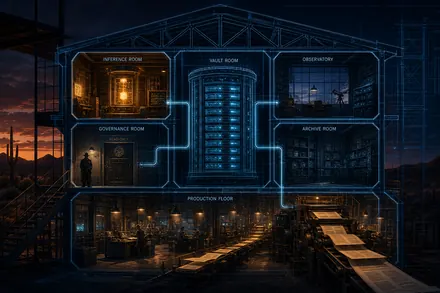
The Writing Room Is a Building Now
Commercial AI writing tools are products built for a market. This one shows the docker-compose.yml of a production system built for a single novel series, names every service and governance boundary, and commits to open-sourcing the stack.
2,106 words
-
The Camera Is Bolted to One Head
Every point-of-view narrator is unreliable because their ground truth is true only relative to them. The room stores one objective board plus N relative truths, and each chapter renders one character’s truth while the model is forbidden to narrate from the board it can see.
2,639 words
-
The Room Has Two Chairs
A writing room is a real institution built to solve one problem: many hands, one voice. That is the AI-assisted author's problem exactly. Showrunner and Authorizing Official are two separate chairs, craft authority and risk authority, and working alone means holding both.
5,313 words
-
The Editing Interface
The console that lets a human, not the model, correct VoT canon is four web forms (Book, Character, Location, Coterie) that replaced a spreadsheet a live relational database outgrew, and most of what each form holds is not correction data at all, it is the brief the AI drafts against.
1,660 words
















Field notes
14 entries · newest firstPieces from the same work that were not written as part of the series. They do not build on each other and there is no order to keep, so these run newest first. Read any of them on its own.
-
The Writing Room Has a Physical Layer, or What Happened When I Read the Firewall Instead of My Notes
The discipline that keeps the writing room's canon honest, read the source and never your memory of it, is the same one that keeps infrastructure claims honest: I nearly published a false claim that my network was flat, sourced to my own six-day-old planning doc, until I read the actual firewall ruleset and found the IoT already segmented.
1,473 words
-
Your AI Policy Isn't Governance, or the Difference Between a Reminder and a Control
AI policy documents are discretionary controls that degrade under cognitive load; architectural governance through mandatory controls (read-only data surfaces, automated constraint execution, enforced generation/decision pipeline separation) is the only sustainable AI governance approach because the wrong action becomes impossible rather than merely prohibited.
1,803 words
-
Synthesis Layer, Why I Didn't Build a Wiki
At sufficient scale and relational complexity, the synthesis layer belongs in a database with enforced schema (schema-as-constraint) rather than a wiki with a schema-as-prompt -- because the database engine enforces structure on every write without requiring the AI to remember the policy, and the AI that got the schema wrong last time can't corrupt prior records.
3,337 words
-
Safety First Is Not Security First
AI safety and AI security are two different disciplines with different threat models, different mitigations, and different failure modes -- conflating them produces systems that are neither safe nor secure, and Anthropic's Constitutional AI addresses alignment but not the infosec attack surface.
3,948 words
-
When the AI Service Dog Loses the Plot
MCP servers need a read-only enforcement layer -- giving AI tools write access to your data is like training a service dog without a "leave it" command, and the correct architecture classifies data by sensitivity before deciding which tools get which access level.
1,796 words
-
"Wait, What Was I Doing?" or Why Your AI Starts Acting Like an Alzheimer's Patient
LLM performance degrades predictably as context fills -- not randomly, not due to hallucination, but because the model's attention mechanism weights recent tokens over early ones, and the fix is externalized memory architecture, not longer context windows.
2,031 words
-
Three Phases to Publish
AI-assisted publishing requires three distinct phases -- brief, draft, edit -- run in separate context windows, because collapsing them into one session produces sycophantic output that reflects what you told the AI you wanted rather than what the work actually needs.
3,609 words
-
Tracking Your Series or How to Prevent Continuity Issues
A series tracking spreadsheet is not a series bible -- it is a relational record of what happened chapter by chapter, with bidirectional cross-book relationships columns, so the mistake that's invisible at the cheapest point to fix doesn't become visible at the point where it costs the most.
1,574 words
-
Voice is Not Style
Voice is the accumulated architecture of a character's first language, region, generation, class, religion, and contact zones -- not stylistic flourish -- and AI needs this structured as data fields, not prose description, to produce consistent character-specific dialogue.
1,206 words
-
The Architecture Underneath the Writing Room
The writing room is not a prompt -- it is an automated infrastructure stack of MCPs, scheduled tasks, databases, and quality gates that runs whether the author is at the keyboard or not, and understanding the architecture is what separates authors who use AI from authors whose writing room runs itself.
1,579 words
-
Local MCPs or how not to expose your data to the Internet
Local MCP servers (stdio, on your machine, nothing crosses the network) and remote MCP servers (hosted endpoint, your data goes there) are architecturally different threat models -- and AI has no parameterized query equivalent, meaning prompt injection through MCP data is a structural vulnerability, not an edge case.
2,727 words
-
Have Some Standards When You Use AI to Write
The failure mode of AI-assisted writing is handing over the wheel -- the tool didn't lower the bar, you did -- and the fix is a specific set of standards that predate the tool, including one gate (dark humor) that cannot be generated because it requires a person who actually finds something funny in a slightly uncomfortable way.
1,090 words
-
Not All Data Is Created Equal
Data classification -- the practice of categorizing data by sensitivity and applying access controls accordingly -- is the missing architectural layer in most personal AI deployments, and treating all data as equally available to AI tools is the root cause of most privacy and security failures.
1,026 words
-
Two-Phase Pipelines, Persistent Memory, and Why RSS Still Wins
Personal AI infrastructure requires a two-phase generate-then-send architecture, SMTP over MCP connectors for scheduled execution, and RSS over homepage scraping -- because silent failures in scheduled contexts are invisible until audited, and the homepage is optimized for humans, not machines.
1,978 words