The imageprompt field solved a visual consistency problem. Your character’s face stays the same across eleven books because the description lives in one record and every scene points at it. The location field solves the next problem: not what your character looks like, but where they are, and whether that place feels the same on page 800 as it did on page 12.
I found out it didn’t. Not because I made a dramatic error, but because I made the quiet kind. The kind that sits in your manuscript for months before anyone notices.
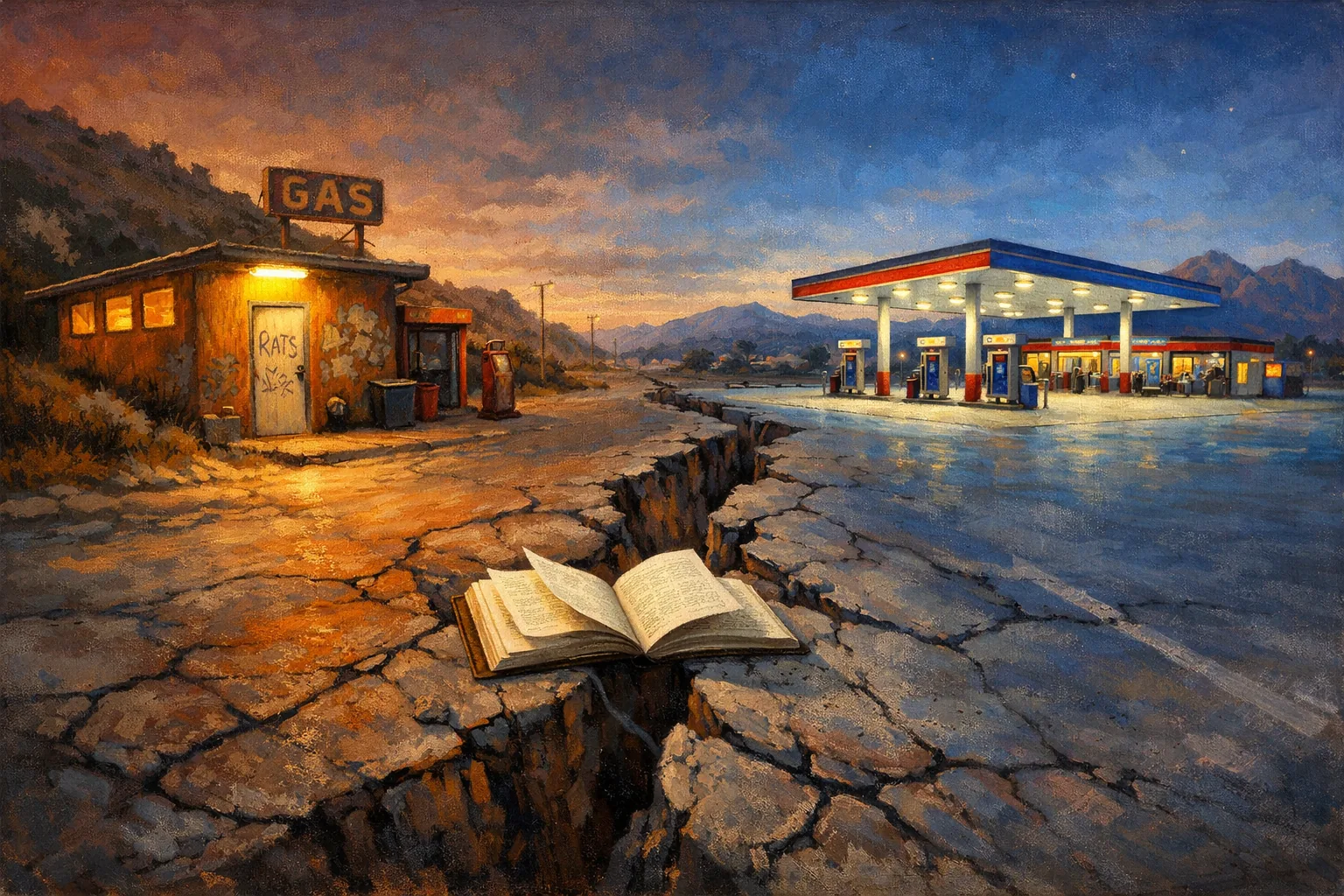
I wrote multiple chapters of Blondie set at a Circle K in Nogales, Arizona. In my head, I was picturing a large suburban station with a wide lot and room behind the building. A ravine back there, maybe. Space to move. I was picturing the wrong Circle K. I was picturing the one in Golden, thirty miles north on Highway 92, because that’s the one I’ve actually been to. When I finally built the location table and opened Google Street View on the actual address (353 AZ-82), the real location appeared: a cramped highway stop with a desert scrub hillside pressed immediately against the east side of the building. Tight lot. Graffiti-tagged exterior bathroom with a combination lock. No ravine. No wide lot. A hillside close enough to bury a body in.
The writing had to account for what was actually there. And the only reason I caught it was that the location table forced a verification pass I’d never have run otherwise. Memory said ravine. The database said hillside. The database was right.
That is the entire argument of this post in one anecdote. Your setting is not what you remember. It’s what you wrote down, verified, and pointed at from every chapter that uses it.
The ID Is Not the Name
The location field in a chapter row stores a location_id. A slug-style key like crimson-cabaret or bisbee-haven. Not the display name. Not a prose description. A pointer.
The description lives once, in the location table. Every chapter that sets a scene there points at the same record. Change the record, every chapter inherits the change. Store the name in the chapter field instead, and you’ve broken the relational chain. The place name drifts, the lookup fails, the AI hallucinates a description from nothing because there’s nothing to look up.
This is database normalization applied to fiction. It sounds technical because it is. The payoff is simple: your setting is defined once and never re-described from scratch.
Movement Encoding: The > Syntax
A chapter’s location field can hold more than one location. The > separator encodes movement:
our-lady-sierras > bisbee-chevron is two stops, one chapter.
lavender-pit > garfield-park-bisbee > bisbee-haven is three stops, a night’s journey through Bisbee.
canyon-general-palominas > canyon-general-hereford > speedway-ramsey > circle-k-golden is Dani’s four-gas-station reconnaissance sweep along Highway 92, encoded in one field.
bisbee-haven > (san-pedro-house) > abuelas-place carries its own grammar. The parentheses mark a waypoint passed through but not a full scene stop. The chapter moves through San Pedro House without landing there. The parenthetical tells the AI: this place exists in the geography, acknowledge it in transit, but don’t load it as a scene.
The field isn’t a tag. It’s an itinerary.
must_mention: The Showrunner Note
The most useful data in a location record isn’t what the place looks like. It’s what must be present every time a character enters.
Bisbee’s haven has multiple coffee mugs cooling on the kitchen counter. Coffee brewed and poured out nightly, never drunk. Miss it once and a dozen chapters of character consistency collapse, because the coffee ritual is how Bisbee processes the night. It’s not flavor. It’s characterization through setting.
Abuela’s place has spiced goat blood in a ceramic bowl (cinnamon, cloves, honey), myrrh-copal-blood-coffee scent layering, and the silver crucifix above the couch. The crucifix is present in Books 1 and 2, then removed. That removal is itself a story beat, tracked in the must_mention field with a version note, not left to the author’s memory of when it happened.
The Crimson Cabaret has velvet drapes pulling light into themselves, upholstery the color of wounds that healed dark, and shadows curling from baseboards like smoke and hate when necromancy activates. That last detail isn’t flavor text. It’s a production note. The same way a TV showrunner leaves a note that a character always enters through the back door, must_mention is the standing instruction that survives context window resets, new sessions, and eleven books of accumulated detail.
One thing the field doesn’t mean: repeating every item on every visit. The first time a character enters Bisbee’s haven, you lay all of it down. The coffee mugs, the kitchen light, the smell. The second time, you pick one or two. The mugs are enough. The reader already built the room. What must_mention gives you isn’t a script to recite. It’s a menu to select from, with the guarantee that you won’t forget what’s on it.
Without this field, every new writing session starts from zero on sensory grounding. The AI doesn’t remember what Bisbee’s kitchen smells like. You have to tell it. Every time. Or you put it in one record and point at it.
The Crimson Cabaret Has a Soundtrack
The Crimson Cabaret’s design concept is stated in the location record: “1920s skeleton with 2024 muscle.” That’s not a mood board note. That’s Vera’s biography compressed into six words.
Vera was born in 1901. She ran burlesque clubs and brothels in Prohibition-era Chicago, staged scandalous shows at a venue called The Crimson Macabre, and was the lover of a Chicago Outfit gangster named Vincent “Schemer” Torrino. She was turned in 1926.
When she finally fled Chicago at the turn of the millennium and built the Crimson Cabaret in the Tucson desert, she didn’t recreate The Crimson Macabre. Chicago was ash. This was something new. The bones of it, though, the jazz-age geometry of velvet and red light and women commanding a room, that’s hers. It’s what she knows. It’s who she was before the teeth.
The sensory_signature field encodes that history in sound. Three layers: electro-swing on top (Caravan Palace, Parov Stelar), trip-hop underneath (Thievery Corporation, Massive Attack, Bonobo), drum and bass in the floor (London Elektricity, Calibre, Netsky). The electro-swing is 1920s jazz vocabulary run through modern production. The skeleton. The trip-hop carries the same late-night weight the jazz age had, updated for a room that’s survived a century. The DnB is the muscle that wouldn’t have existed in 1924 but feels structurally correct in a speakeasy that made it to 2024.
The bass registers in the chest. Calibrated to sit just under conversation. Characters don’t shout across the Crimson Cabaret. They lean in. That’s not atmosphere. That’s a constraint on how every scene in this location gets written. The sound architecture defines the social geometry, and the social geometry is Vera’s. She built the room so that every conversation happens on her terms, at her volume, in her aesthetic. The playlist is a character study you can listen to.
A location record can carry a Spotify playlist. Not a reference document. The actual tool the author uses while writing scenes there. For writers who don’t work with music, the sensory_signature field carries the same information as prose. Either way, the AI knows what the room sounds like.
Time Signature: The Bell Curve
A location isn’t a static set of sensory data. It breathes.
Document two points: the location at its absolute busiest, and the location at its absolute emptiest. The bell curve between them generates every other moment.
The Crimson Cabaret at peak: Hispanic house girls wearing skimpy black or crimson lingerie in mapped rotation, vampire assembly past nine, compulsion thick in the air, every angle calculated for commerce and beauty, Kyle Brandt working the room. The Crimson Cabaret at its emptiest: Vera alone at the antique desk with the banker’s lamp. Hardwood heel-click in silence. Crystal decanter catching amber light. That is the more dangerous state. A room full of vampires is manageable. Vera alone in her sanctum means something has required her full attention.
Bisbee’s haven peaks at two people. The safe house never has a crowd. Its busiest state is a traumatized fledgling in the guest room and Bisbee in the kitchen brewing coffee, honoring friends who died in a war he can’t escape, coffee he can’t drink. Its emptiest state is the same kitchen with one more cold mug on the counter.
Most scenes don’t happen at either extreme. They happen on the slope. Knowing both endpoints lets you place any scene accurately without re-inventing the location from scratch. The AI knows what “Crimson Cabaret at 60% capacity” feels like because you told it what 100% and 0% look like. It interpolates. That’s what bell curves do.
How the Location Record Gets Built
For real-world locations, the workflow has three passes:
First, the author briefs the AI on what they know. Claude drafts the initial record from that brief, filling the field schema from whatever description the author provides. This is the fastest pass and the least reliable, because it’s built on the author’s memory. Which, as the Circle K proved, is not always right.
Second, Google Maps satellite view verifies terrain, confirms GPS coordinates, and catches mismatches between imagination and reality. This is where the Circle K story happened. Street View showed a building that didn’t match what was in the draft. The location record got corrected. The chapters got corrected. The manuscript is now accurate to the actual geography of Nogales, Arizona, and not to a gas station thirty miles away that I confused it with.
Third, for locations where street-level detail matters, Claude in Chrome pulls building condition, signage, neighboring structures, approach angles. The kind of detail that makes a character’s approach to a building feel grounded instead of generic.
For non-real-world locations, there’s no Google Maps. The schema becomes the interview. Every field is a question the author answers from imagination, and the AI runs that interview systematically. The spaceship engine room has its own sound signature (hull hum becomes physical pressure near engineering, drops to subliminal in crew quarters at 0300). The fantasy tavern has its own must_mention (the wanted poster that’s been on the wall so long nobody sees it anymore). Same structure. Different answers. Same consistency payoff.
The interview prompt at the end of this post works for a real-world location at 2 AM. Ask your AI to help you adapt it for yours.
Continuity Architecture
The location table tracks more than description. It tracks state across the series.
books_present records which volumes a location appears in. state_end_vol1 and state_end_vol2 are continuity snapshots after each book. changes_notes records how the location evolves, or doesn’t.
The Crimson Cabaret’s changes_notes entry reads: “No physical changes; political geography shifted significantly.” The building is identical. The velvet drapes haven’t moved. The chandeliers still bleed amber. But by the end of Book 6, Kyle Brandt has committed an act of violence in it, Kendra is a chess piece in motion, and Vera’s command structure has reorganized around a threat the location itself absorbed without showing a mark.
That distinction matters. Generic wiki tools track description. This tracks consequence. NovelCrafter’s Codex tracks locations as entries you can link to scenes. Sudowrite’s World Bible stores worldbuilding elements including locations. SidekickWriter’s World Bible lets you create locations with descriptions and tags. All three store what a place is. None of them have an equivalent for what a place has become after six books of accumulated narrative consequence. They store the noun. This stores the verb.
The Abbreviated Schema
The full location record has 28 fields. Here are the ones that do the most work:
| Field | What It Does |
|---|---|
location_id |
Slug-style primary key. The pointer every chapter uses. crimson-cabaret, bisbee-haven, circle-k-nogales. |
display_name |
Human-readable name for prose. What appears in the manuscript. |
sensory_signature |
Dominant sensory experience: sound, light, temperature, ambient feel. Carries artist/track references for locations with playlists. |
scent_notes |
Baseline smell. Separated from sensory_signature because scent is the one sense AI most consistently drops. |
must_mention |
Standing production note. What must be present every time a character enters. The showrunner field. |
time_signature |
Busiest and emptiest states. The bell curve endpoints. |
survival_rules |
Hazards, access control, protections. Who can enter, who is barred, what happens if you’re wrong. |
changes_notes |
How the location evolves across the series. Physical changes, ownership shifts, narrative transformation. |
state_end_vol1 / state_end_vol2 |
Continuity snapshots. What the location’s status is after each book closes. |
The remaining 19 fields cover exterior/interior description, zone maps, character associations, GPS coordinates, emotional register, and first appearance tracking. They matter. They just don’t need a table to explain.
The Location Interview Prompt
This prompt builds a location record from scratch. Paste it into your AI of choice, answer the questions, and you’ll have a working location entry. It’s designed for real-world locations, but every question except #21 applies to constructed worlds, space stations, and fantasy taverns.
You are helping me build a location record for my story. Ask me these questions one at a time. Wait for my answer before moving to the next. If my answer is vague, ask one follow-up to sharpen it, then move on.
- What is this place called formally, and what do characters actually call it day-to-day?
- What type of place is it: shelter, gathering point, transit stop, sacred site, command center, something else?
- Where is it located in your world: region, district, neighborhood, or planet?
- What does a character perceive before they enter, on approach, from outside?
- What does the interior feel like? What are the zones, the sight lines, the exits?
- Does this place have distinct zones with their own sensory signatures, or is it uniform throughout?
- What is the dominant sensory experience here: sound, light, temperature, ambient feel?
- What does it smell like under normal conditions?
- Are there smells that only appear under specific conditions?
- What sounds come from outside this place? What does the outside world sound like from inside these walls?
- What are the survival rules? What hazards exist, who can enter, who is kept out?
- Who belongs here? Who passes through regularly but doesn’t live here?
- What story job does this place do? Is it where characters make decisions, find shelter, face consequences?
- What object, sound, or smell must be present every time a character enters this space?
- Are there scenes or moments that happen here repeatedly?
- What objects or fixtures recur and matter to the plot?
- What is the physical condition and visual register of this place?
- What does a character feel walking in here for the first time? Not an emotion they choose. A physical reaction.
- Does this place affect one character differently than the others?
- When is this place at its absolute busiest? At its absolute emptiest? The bell curve between those two answers is every other moment in this location.
- If this is a real-world location, what does Google Maps show that you need to get right? If it’s constructed, skip this and work from your imagination.
- Where does this location first appear in your story?
- Which volumes or books does it appear in?
- How does this place change across your story, or does it stay fixed while everything around it shifts?
The interview above works for a real-world location at 2 AM. Ask your AI to help you adapt it for yours.
Closing
The imageprompt field stored a face. The location field stores a geography. But geography isn’t static. It breathes, it accumulates history, it sounds different at peak capacity than it does at 3 AM when one person is left in it.
The FK relationship is the thesis. Locations don’t live in your chapters. They live in one record, and your chapters point at them. One change propagates everywhere. One verification pass covers every scene. One must_mention survives every context window reset.
That’s not a database trick. That’s how continuity works across eleven books. Or it’s how your Circle K ends up thirty miles from where you thought it was, and you don’t find out until the location table makes you look.
You may also like:
- The imageprompt Field or Your Character’s Eye Color Doesn’t Change in Book 6
- “Wait, What Was I Doing?” or Why Your AI Starts Acting Like an Alzheimer’s Patient
- Worldbuilding Vampires with the Apocrypha
- Rocket - Prologue