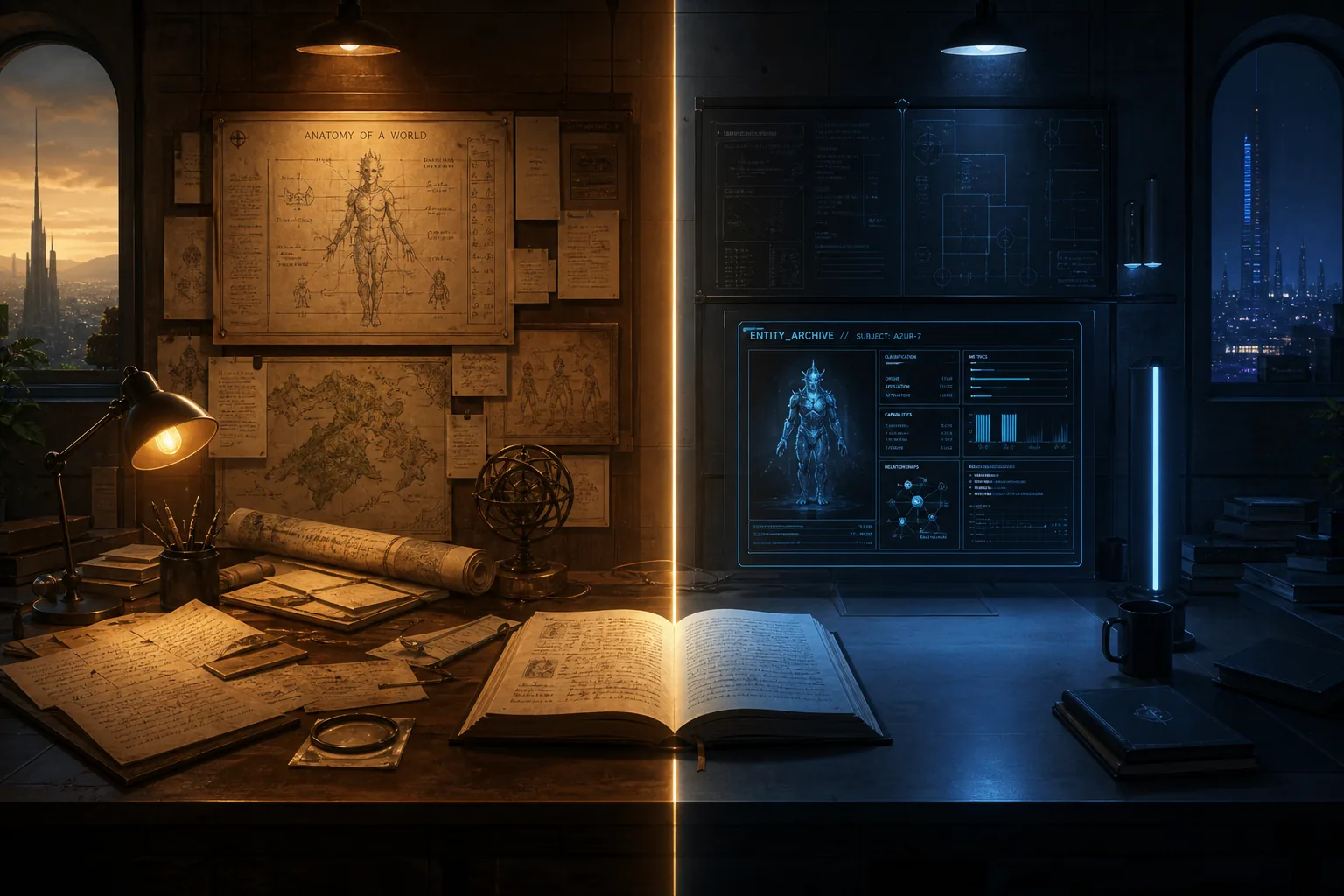
Every serious writer has built a world. The question is which reader they built it for.
Randy Ellefson wrote three volumes on how to do it, The Art of World Building series, and across Creating Life, Creating Places, and Cultures and Beyond he lays out gods and species and climate, how to calculate travel time by horse or wagon or dragon, legal systems, languages, and names, the most thorough treatment the form has and every page of it built to be read by a person. Patricia Wrede’s worldbuilding questions, the ones that have circulated among fantasy writers for decades, do the same job in checklist form. World Anvil has more than three million worldbuilders building wikis inside it. Inkarnate renders your map.
All of it works. None of it is wrong. If you have lore documents, a World Anvil subscription, and a commissioned map on the wall, you did the work, and the work was right.
It was right for one reader. There was no second reader until now.
The Second Reader
Your AI is a second reader with different format requirements. The worldbuilding tradition could not have planned for it, because the tradition is older than the reader.
Here is the difference, stated plainly. When you read your lore document, you absorb it and carry it forward. When the AI reads the same document, it does something else. It blends. It takes the prose you handed it and generates something that sounds like your world, assembled out of the statistical shape of the words you happened to use rather than retrieved from a record where each fact sits in a named field with one correct value. That is not the same operation as looking a fact up.
A document is something the AI reads and approximates from. A database row is something the AI retrieves an exact value from. “The AI found the paragraph about sunlight” and “the AI queried sun_exposure and got back annihilation” are not the same sentence. One is close. The other is correct.
This is where World Anvil’s “Sage” assistant earns its place in the argument. Sage reads your wiki articles and calls that AI worldbuilding. It is. It is just not queryable worldbuilding. “The AI can read this” and “the AI can retrieve specific facts from this on demand” are different claims wearing the same coat. The gap between them is exactly wide enough for your character to end up in the wrong city.
I have written about that failure before. A Circle K in one of my books drifted thirty miles from where the manuscript thought it was, and the location table is what caught it. That was one row. The argument here is bigger than one row. It is about the whole stack of documents a writer builds, and which of them the AI can actually use.
What the Tradition Produced
I will use my own writing room as the worked example, because I built the full arc and I can show you every layer.
Vampires of Tucson has four worldbuilding documents that predate the database. Walk them in order and the two-reader problem walks out into the open.
The Master Lore Document is first, the definitive reference, more than two thousand lines holding every rule and every piece of history in one place, and it is also too large to load into a session without burning the context window to ash, which leaves it sitting in my files as the canonical source and the least usable artifact I own at the same time, for the same reason.
The AI Summary is second. It is a compressed version of the lore, written specifically so the AI can hold the rules in working memory. It opens like this:
A vampire is a human soul in Divine Suspension. A dead body animated by the suspended soul, not biological. No heartbeat, no breath, no body heat. Driven by the Starved Soul, an amplified human instinct, not a demon.
That is a rules document, and it is good at being one. The metaphysics the series runs on are in there too, and I am not going to unpack them here. The point is what the summary does well. It tells the AI what a vampire is. It tells the AI what is forbidden and what cannot happen, the hard physical laws the fiction never breaks.
Here is what it cannot do. It cannot tell the AI that Vera arrived at Bishop’s haven in Q3 2000. It cannot tell the AI what the Crimson Cabaret smells like, who owns it, or whether sunlight reaches the floor. Those are not rules. They are facts, and a rules document has no slot for them.
The AI Summary is not failing when it cannot answer those questions. It was never built to. Rules and facts are different layers, and the summary is doing its layer correctly.
The third document is world.html, a visual geographic reference I open in a browser and scroll. It maps the territory the books move through. It is for me. I look at it to remember where things sit relative to each other. The AI does not read it and does not need to. It is the right format for its reader, who is human.
The fourth is Physiology.txt, the original source notes on how the vampire body works.
A vampire cannot blush. Its ears cannot turn pink. It cannot eat or drink anything but blood without purging it later, because any physical reaction that needs blood flow is verboten.
That document did not stay a document. Its contents were processed downstream into the standards the writing room runs on, the constraint layer that governs every chapter. The rules in it became rules the system enforces, not prose the AI re-reads each session.
Four documents. One too large to use, one that holds the rules, one that serves the author’s eye, one that became infrastructure. That arc is this whole article in miniature.
The Conversion
“Convert your documents” sounds like a chore with no edges. It has precise edges. It is a sorting problem with two bins.
The first bin is rules. How things work, what is forbidden, what cannot happen. The vampire metaphysics. The physiology.
These belong in your standards document and your constraint layer, the same place the AI Summary and Physiology.txt ended up. Here is what that conversion produced, a section the writing room loads every session:
Section 6: Physiology Rules (Vampire Metaphysics)
Scene Timing Default
All scenes occur within the vampires’ active window: no earlier than 1 hour after local sunset, no later than 1 hour before local sunrise. Exceptions require explicit justification:
- Dream or vision sequence
- Day-sleep (torpor) flashback
- Sealed or lightproofed location with no sun exposure
- Ghoul or human POV chapter
Vampires are death-unconscious during daylight hours. No awakening by normal means.
Core Rules
- No biological vampirism language (heartbeat for life, digestion, body heat, goosebumps)
- No fatigue, no physical exhaustion (spiritual/supernatural energy drain acceptable)
- No breath except for speech (atmospheric breathing acceptable for panic/habit)
- No conventional sleep (daylight dormancy only)
- No headaches, no hunger pangs (spiritual hunger only)
The AI does not need to retrieve a rule on demand. It needs to hold the rule and never break it, and a standards document is the right home for a thing the AI must always obey.
The second bin is facts. Who is where, when, what happened, what a place looks like. Vera at Bishop’s haven in Q3 2000. The Crimson Cabaret’s owner, its sun exposure, its scent. These belong in schema rows, a character table and a location table and a chapter table, and the AI does not hold any of them in working memory the way it holds a rule, it looks them up, one exact value at a time, in the moment the scene reaches for them.
The clearest version of the split is world.html against the location table. They cover the same desert. The map page is the visual reference I read. The location table is what the AI queries. Same territory, two formats, two readers.
The map renders the geography for my eye. The table returns the Crimson Cabaret’s sun exposure for the AI’s query. Neither one can do the other’s job, and neither one should try.
This is the line that separates the database from the platforms. World Anvil, Campfire, and Inkarnate all produce something a human navigates. A wiki you click through. A map you scan. They serve the first reader well, and some of them serve that reader beautifully.
What none of them produce is a value the AI retrieves on demand. World Anvil hands you the article about the place. The database hands the AI the field.
Here is the artifact. Run it against every worldbuilding document you own.
THE TWO-READER AUDIT

For each document you have, ask three questions.

1. Which reader is this for?
   - Author only (a map, a visual reference, a lore doc you consult)
       keep it. It is doing its job.
   - AI only (a prose summary you paste into context)
       convert it, or it will drift.
   - Both
       you have already started this work.

2. If it is for the AI, what kind of content is in it?
   - Rules and metaphysics (how things work, what is forbidden)
       belongs in your standards document and constraint layer.
   - Facts (who is where, when, what happened, what a place looks like)
       belongs in schema rows: character, location, chapter tables.
   - Both
       split it. Rules to standards. Facts to schema.

3. Has it been converted?
   - Yes        the AI can query it.
   - No         the AI is blending from memory.
   - Partial    (an AI summary, a compiled wiki) better than nothing,
                still not queryable.
If you want the build-out of the facts side, the export pipeline that gets those rows in front of the AI lives in Bringing It All Together. This post is the argument for why you bother.
The Scale Problem
One more case, because the pattern holds where you would least expect it to.
Science fiction at galactic scale breaks the map worse than fantasy ever could. Douglas Adams said why, in 1979, in the fewest possible words:
“Space is big. You just won’t believe how vastly, hugely, mind-bogglingly big it is. I mean, you may think it’s a long way down the road to the chemist’s, but that’s just peanuts to space.” Douglas Adams, The Hitchhiker’s Guide to the Galaxy, 1979
A map is flat. Space is not. The Milky Way does not flatten well, and the moment you render three dimensions of relationship as a two-dimensional picture you have thrown away the part that mattered.
Jack Campbell understood this in The Lost Fleet. His ships do not cross open space to anywhere they please. They travel through jump points, fixed connections between specific stars, in a network where not every star links to every other. The jump points are not scenery. They are nodes, and the routes between them are edges, and which star connects to which is the entire tactical problem of the series.
That is a database. A jump-point network is a relational structure: nodes, the connections between them, the cost of crossing. Campbell was already storing relationships instead of rendering a picture, because at that scale the picture lies and the relationships do not. The map fails. The database survives. It survives because it stored what was actually true, which was never how the galaxy looked, only how its parts connected.
Two Readers, One World
The worldbuilding tradition is not wrong. Ellefson is not wrong. Your map is not wrong. They were built for a reader who reads the way you do, and that reader still matters and is not going anywhere.
There is a second reader at the table now. It does not read the way you do. It retrieves. It needs facts in rows and rules in a standard, and it will quietly invent anything you left only in prose, so that when you hand it a document it hands you back something that merely sounds like your world, and when you hand it a database it hands you the world itself. Hand it a document and you get an echo. Hand it a database and you get the place.
Your world has two readers now. Build for both.
You may also like: - How Your Setting Drifts When Nobody’s Watching - Bringing It All Together - Synthesis Layer, Why I Didn’t Build a Wiki