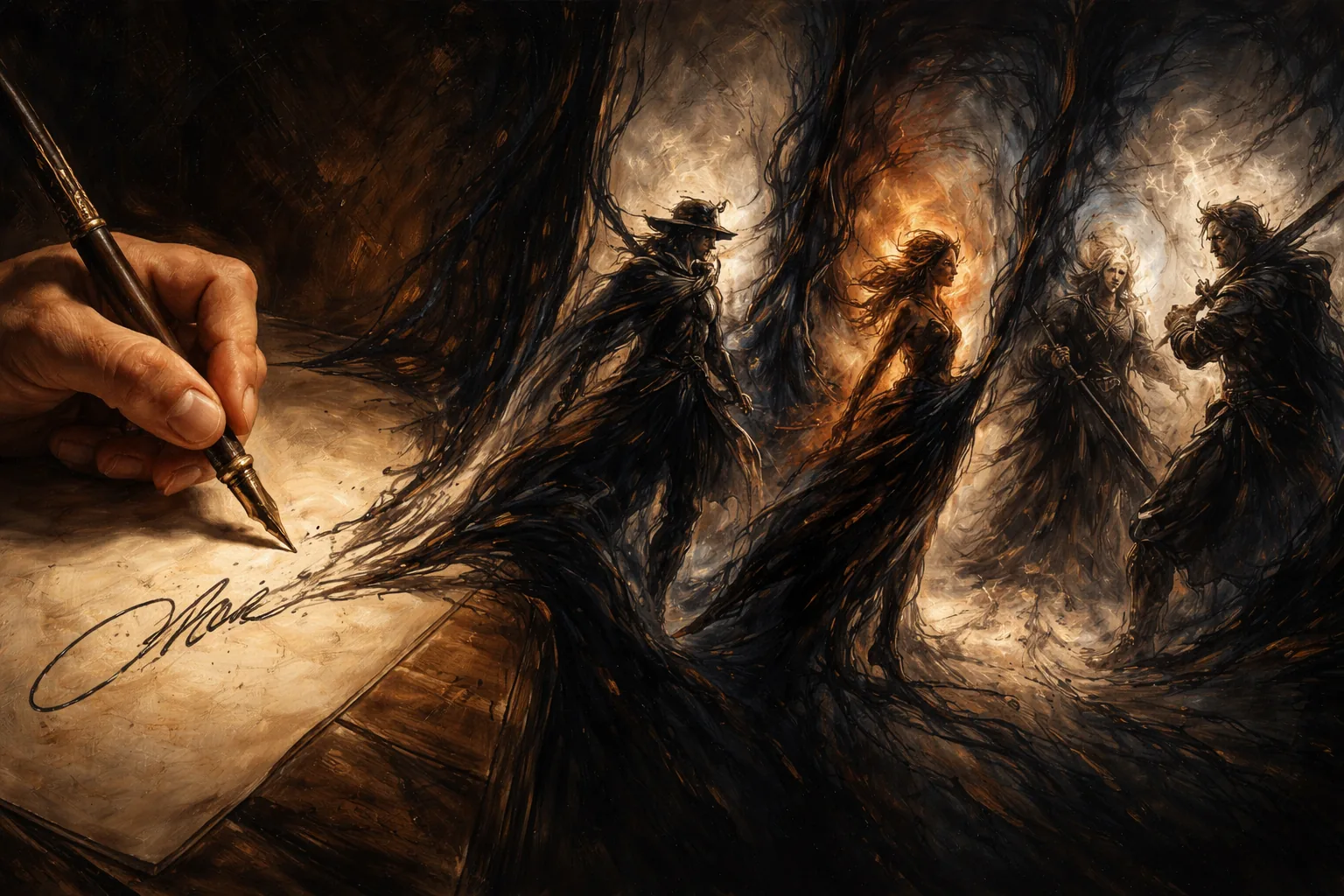
Style is what you do. Voice is what they do.
These are not the same thing, and your AI does not know the difference unless you tell it explicitly. Even then, it has to fight its defaults to honor it.
What Style Is
Style is the fingerprint an author leaves on prose. Sentence rhythm, word choice patterns, the structural preferences that accumulate across a body of work until they become recognizable. Cormac McCarthy doesn’t use quotation marks. Elmore Leonard’s rule was to leave out the parts readers skip. These aren’t accidents. They’re the decisions of someone who has written enough to develop a signature.
Style lives in the narration. It’s the prose layer underneath and around the characters.
What Voice Is
Voice is the fingerprint a character leaves on speech. It’s built from who they are, where they grew up, what language shaped their first thoughts, who raised them, what they survived, and which drawer of their brain they reach into first when they need words. Voice is not decoration. It’s the output of an entire architecture that was built before the scene you’re writing.
Voice lives in the character. It belongs to the dialogue and interior experience of a specific person in your story.
These operate at completely different levels of the manuscript.
Where It Goes Wrong
When writers say “write this scene in [character]’s voice,” they usually mean: make the dialogue sound distinctive. Spray in some dialect markers. Make them sound a little different from the other characters.
This is not wrong. It’s just not enough.
When you hand AI a chapter and ask it to continue “in this character’s voice,” what you’re actually giving it is your style. It reads your sentence rhythms, your word preferences, your structural patterns, and then it reproduces those patterns wearing whatever dialect markers you’ve associated with the character. The character ends up sounding like you doing an impression of them.
That’s not voice. That’s ventriloquism.
The Test
Take any scene with two characters talking. Cover the dialogue tags. If you can tell who’s speaking from the lines alone, you have voice. If you can’t, you have style wearing different costumes.
Most first drafts fail this test. Most AI output fails it worse, because AI’s default is to produce coherent prose in the author’s register, with “character voice” as a modifier rather than a separate input. The model is not distinguishing between your fingerprint and your character’s fingerprint. It’s running both together into one output.
This is not a bug. It’s a training artifact. The model learned to produce consistent prose within a style, and it’s doing exactly that. You just asked it for something more specific than it knows how to separate on its own.
The Author or the Prose
It’s three in the morning, or maybe five. The room is wrong in the way unfamiliar rooms are wrong before your eyes adjust. There’s warmth next to you that has no business being there. You come online in pieces, running a slow inventory of what you remember, and then the thought arrives fully formed before you’re ready for it.
Did I? Did we?
Universal situation. Primal dread. Every person who has ever been in this position knows exactly what the next thirty seconds feel like.
Now run it through three different voice architectures and watch what happens.
The author (plain, standards-compliant):
“There was someone in my bed. That was new. I ran the previous eight hours backward and stopped somewhere around the second drink.”
Betsy Bishop (born 1676, Salem; Puritan structure, pirate years, 350 years of accumulated contact zones):
“There was a warm body beside me, which was not the circumstance I had retired expecting. I reviewed the evening’s accounting. The rum had been generous. I had apparently been more so.”
Rocket (16, Gen Z Latina, trafficking survivor, still learning to trust):
“Oh no. Oh no no no. Okay. Don’t... just breathe. ¿Qué hice? I didn’t... did I? No. I would remember. I’m pretty sure I would remember. Ay, Dios mío.”
Same scene. Same first thought. The author’s version is dry and controlled. That’s the standards document. Betsy reviews it like a ledger, because 350 years teaches you to account for things rather than panic about them. Rocket’s breaks into Spanish at the exact moment the emotion exceeds what English can hold.
Cover the names. You know exactly who is speaking.
That’s the architecture doing the work. Not the dialect markers. The whole person underneath.
What to Give It Instead
Style and voice need to be treated as separate inputs. Both need to be documented explicitly.
My author voice is my writing standards document: the em dash ban, the dark humor requirement, the structure rules, the banned patterns. That’s my fingerprint on prose, written down. My character’s voice is the aidialogueprompt field in the character schema: the full architecture of who they are and how they speak, built from region, generation, first language, religious upbringing, and every contact zone they’ve accumulated.
Two documents. Two levels. Neither left for the model to infer.
Voice has to be built deliberately and provided explicitly. Not “this character is sarcastic” or “she’s from Texas.” The actual architecture: what language built their first thoughts, what region shaped their vocabulary, what class and education and religious upbringing they carry into every sentence. The dialect markers come last. They’re the artifact you earn after the architecture is built.
Give the model an accent and it’ll give you a costume. Give it the architecture and it’ll give you a person.
I did a full breakdown of how to build that architecture over at Architecting the Writing Room. That’s the technical how-to. It comes out this Wednesday, April 1, at 6 AM. This is the prerequisite: knowing the problem exists and understanding what you’ve been conflating.
The Failure Mode
The writers who skip this step don’t find out immediately. The first few chapters, the dialogue feels lively enough. The AI is generating, you’re editing, things are moving.
Then you read it back. Everyone in every scene is... basically... you. With regional accents.
Your protagonist makes dry observations in exactly the cadence you favor. Your villain is sarcastic in a way that sounds oddly familiar. Your secondary characters have surface differences but the same underlying brain. They all reach for the same kinds of metaphors. They all navigate conflict with the same rhythm.
You’ve written a very accomplished ventriloquism act. Four characters. One voice.
This is fixable. It just requires going back and doing the work that should have happened before the AI ever touched a scene. The longer you wait, the more there is to untangle.
The Short Version
Style is what you do. Voice is what they do. Your job is to know the difference before you hand either one to an AI that can only separate them if you build the distinction into what you give it.
The model is not the problem. The model is a mirror. It reflects what it receives.
Give it your voice and your characters’ voices, undifferentiated, and that’s what comes back. Every time.
You may also like: - Have Some Standards When You Use AI to Write - What Makes A Writer - Trauma and You... - Rocket’s Story starts here