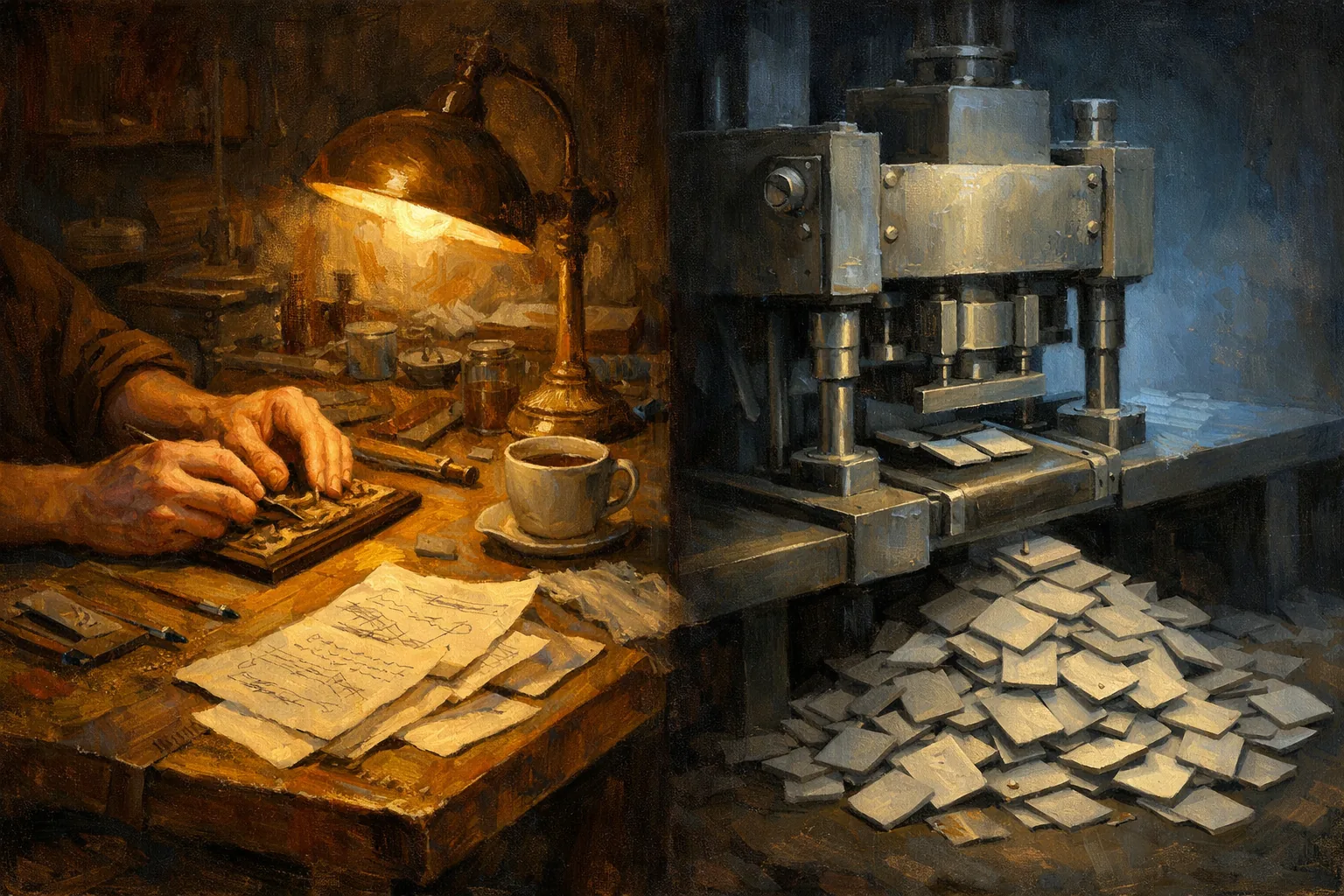
I use AI to write. I want to be upfront about that before this turns into something it isn’t. This is not a rant against AI writing.
AI assists me in creating volume. It doesn’t replace my thinking, it puts words to the thinking I’ve already done.
I came across a personal finance post recently (I won’t name it) that used one sentence per line, an ellipsis every third paragraph, and the phrase “something shifts” as a section closer. My head hurt reading it. Not because it was wrong, exactly. Because it was performance all the way down.
In Defense of the Style
The style isn’t without logic. Short lines lower the activation energy for someone reading on their phone at 6am before the kids are up. Emotional coaxing works for an audience that needs to feel seen before they’ll take advice. For a general audience working through credit card debt, the “you’re not behind, you’re just ready” register probably converts. I am not that audience. That doesn’t make the style a failure.
The audience this style is written for is real. They show up in the comments saying this post changed their life, which sounds hyperbolic until you remember that some of them were in their car in a parking lot when they read it, running numbers they already knew were wrong. The short line is a hand reaching through the screen. The emotional register is calibrated to someone who needs permission before they can take advice. That is not condescension. That is meeting people where they are.
What bothers me is that this particular post almost certainly feels AI-generated. Not because AI is bad; it’s just not my style. I fancy myself a novelist. I do complete sentences when texting. I punctuate. I like to see the whole idea through.
The pattern wasn’t serving the piece. Every sentence the same emotional weight, every pause manufactured in the same factory. It doesn’t feel like a writer at the helm. It feels like a machine put on autopilot and let run willy-nilly.
What It Actually Looks Like
The setup matters. I’ve done the homework. Claude - his default voice sounds like a British male to me, for what it’s worth - has read samples of my actual writing, enough to know how I speak. He knows my intent. That part has a name: Intent Engineering. When I hand him a roadmap, he already knows whose voice he’s serving.
That’s not nothing. In truth, that’s most of it.
Here is what AI-assisted writing looks like when it’s working: you give him that foundation, then a roadmap, and walk through it together, as many times as it takes, until the output is accurate and actually sounds like you. The post I was building this morning, for release next week on Architecting the Writing Room, kept getting additions: the Wisconsin fish fry that outlived its theology, the Thai stepmother who calls her Western husband a farang (the same word as guava, because the Portuguese brought the fruit and the vocabulary traveled together), the Hawaiian word for becoming local over time. None of that is generatable. You can’t prompt for it because it happened to someone specific.
Claude carried the structure. I kept showing up with the “and then.”
The Wrong Fix
The failure mode is handing over the wheel. When the output performs depth without achieving it, you can hear it. “Everything gets clearer.” “You start realizing.” These are the shapes of insight without the content, and a reader who encounters enough of them starts to feel vaguely cheated even if they can’t name why.
The patterns have names, and once you can name them you can’t unhear them.
“Not because you failed. But because you’re human.” That construction pivots on “But” after a period and AI generates it constantly because it feels like a meaningful turn. Stack three of them in a post and you’re reading a formula, not a thought.
“Clear. Focused. Intentional.” Three parallel words, each punched with a period. That is a tricolon, the rhythm of wisdom without the substance.
“What if you could change this? What would that look like? What’s stopping you?” Three stacked rhetorical questions, each manufacturing urgency, none requiring an answer because the goal is the feeling of depth, not the depth.
The em dash is the easiest tell of all. Real writers reach for it occasionally. The generator reaches for it in every other paragraph because it was trained on a corpus where em dashes signal serious prose, and unlike a human writer, it produces one with no friction and no off switch.
Humanizing the output is the wrong fix. The premise is that AI produced something robotic and you’re adding warmth. But the choppy personal finance style IS the humanized version: short emotional lines, ellipsis before the insight. That’s what humanizing produces at scale. It’s not more human; it’s a performance of human. Which, in my opinion, is worse.
The Standards
What works is a specific set of standards that predate the tool. I keep a checklist.
Em dashes are banned. Corporate filler is banned - phrases like “leverage” and “unlock” that signal nobody (or at least nobody worth listening to) was home. Stacked rhetorical questions are banned. Paragraph length is capped. The opening sentence has to earn its place. Every acronym gets defined on first use - you don’t get to assume the reader shares your alphabet.
And there has to be a moment of dark humor in every post. Not optional. The dark humor requirement exists because you can’t generate it; and quite frankly, that’s my general register. You can prompt your way into the shape of dark humor, but the shape doesn’t land. A line that’s actually funny in a slightly uncomfortable way requires a person who finds something funny in a slightly uncomfortable way. It’s the one gate I trust most.
None of this is about making the output sound human. It’s about making it good enough to publish.
The bar hasn’t moved. Claude changes who does the lifting, not what the standard is. Using AI well requires taste that predates AI. You have to know what good sounds like before you can tell when the output isn’t it.
Your readers won’t know you used AI. They’ll just think you’re a bad writer. Which is worse.
I use AI to write. The difference, I hope, is that I stayed in the room, and oversaw the output.
You may also like: - The Architecture Underneath the Writing Room - The Fear Tax - What Makes A Writer